
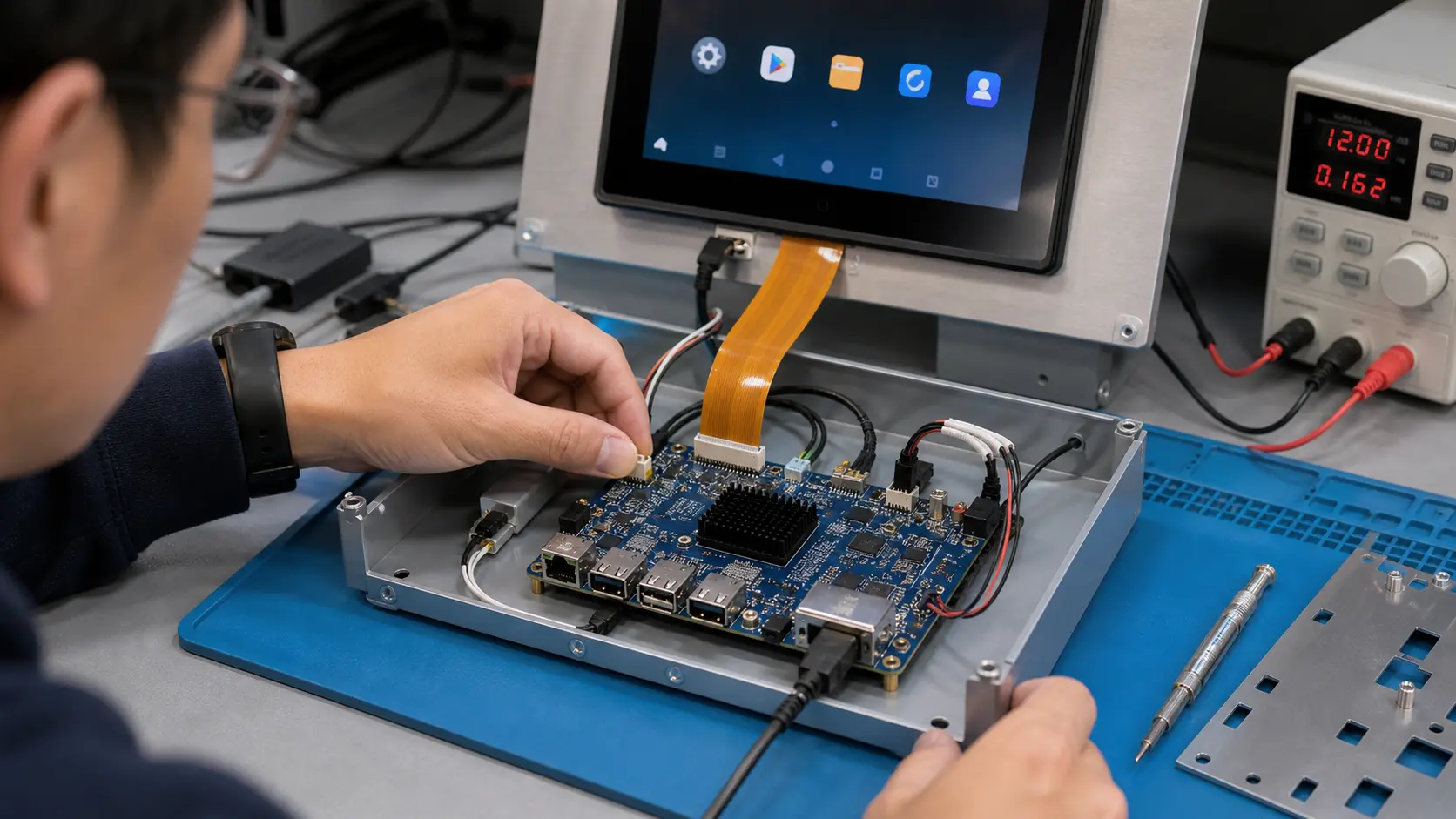
In the embedded world, “dominance” rarely comes from raw benchmark numbers. It usually comes from balance. Over the past few years, Rockchip’s RK3566 has quietly become one of the most commonly selected SoCs for industrial and embedded single-board computers (SBCs).
The reason is straightforward: it delivers the level of performance most real products need, without introducing unnecessary thermal, cost, or integration complexity.
This article looks at RK3566 from an engineering standpoint—why it fits so well into industrial HMIs, smart terminals, and embedded controllers, and what makes it a practical long-term platform.
A Performance Profile That Matches Real Products
Most embedded systems do not need desktop-class performance. They need:
- Smooth graphical interfaces
- Stable networking
- Reliable storage handling
- Moderate multimedia capability
- Predictable long-term behavior
RK3566 provides enough CPU and GPU performance for modern UI frameworks (including Android and embedded Linux environments) without pushing power consumption into problematic territory.
For industrial control panels, kiosks, medical terminals, and building automation systems, this balance is often more valuable than peak synthetic performance.
Strong Display Integration for HMI Applications
A large portion of RK3566 deployments are display-centric. In industrial and commercial environments, the screen is the product’s main interface.
RK3566-based SBCs are frequently paired with TFT LCD panels in common sizes such as 5", 7", and 10.1". These combinations are widely used in:
- Industrial HMI panels
- Smart building controllers
- Access control terminals
- Self-service kiosks
- Edge monitoring devices
Because the SoC includes dedicated display pipelines, engineers can design compact board + display solutions without adding external graphics processors. This simplifies PCB layout, reduces BOM complexity, and improves overall reliability.
I/O Flexibility for Embedded Integration
Embedded products are rarely isolated computing devices. They must communicate with sensors, actuators, microcontrollers, and external systems.
RK3566 platforms typically expose a practical mix of interfaces, including:
- Ethernet for industrial networking
- USB for expansion and peripheral support
- UART for MCU or legacy device communication
- I2C and SPI for sensors and control devices
- GPIO for system-level control
- eMMC and SD for reliable storage
This interface diversity allows a single RK3566 platform to serve multiple product variants with minimal hardware redesign.
Android and Linux: Two Software Paths on One Platform
One reason RK3566 is attractive to engineering teams is software flexibility. It supports both embedded Linux and Android-based systems, allowing product teams to align the OS choice with application needs.
- Android-based systems are often used for interactive devices with rich UIs, multimedia playback, and web-based services.
- Linux-based systems are commonly chosen for gateway devices, networking equipment, and control-oriented applications.
From a system architecture perspective, this flexibility reduces risk. The same hardware foundation can support multiple software strategies across a product line.
Manageable Power and Thermal Characteristics
Thermal design is one of the hidden constraints in embedded systems. Wall-mounted panels, sealed enclosures, and fanless industrial units do not tolerate excessive heat.
RK3566-based SBCs typically operate within a power envelope that is easier to manage compared to higher-end SoCs. This simplifies:
- Heatsink design
- Enclosure selection
- Long-term reliability planning
For devices expected to run continuously in elevated ambient temperatures, predictable thermal behavior is critical.
A Mature and Expanding Ecosystem
Technology selection is rarely just about silicon. It is about ecosystem maturity.
RK3566 benefits from:
- Multiple SBC vendors offering different form factors
- Existing board-level reference designs
- Display integration experience across industries
- Established BSP and kernel support paths
This ecosystem reduces bring-up time and shortens development cycles. Engineering teams can prototype quickly, validate core functionality, and then transition to customized designs with lower uncertainty.
Where RK3566 Makes the Most Sense
RK3566 is not designed to compete with high-end AI acceleration platforms. Instead, it fits extremely well in products that require:
- Industrial-grade HMI performance
- Multi-interface connectivity
- Stable long-term deployment
- Moderate multimedia capability
- Controlled power consumption
Typical examples include:
- Industrial automation terminals
- Smart home control panels
- Medical display interfaces
- Vending and payment systems
- Industrial IoT gateways
In these scenarios, the SoC provides sufficient headroom without overengineering the system.
Engineering Considerations Before Production
Before committing RK3566 to a production design, engineers should still validate key areas:
- Display timing and suspend/resume stability
- Touch controller integration and firmware tuning
- Storage partitioning and OTA update mechanisms
- Thermal performance under worst-case ambient conditions
- Long-term availability from board suppliers
A well-validated hardware and BSP stack is more important than theoretical specifications.
Conclusion
RK3566 has become widely adopted in the SBC market not because it is the most powerful SoC available, but because it aligns well with real-world embedded requirements. It balances performance, power efficiency, I/O flexibility, and software ecosystem support in a way that reduces integration risk.
For industrial and embedded system designers, that balance often matters more than raw computing benchmarks. When properly integrated, RK3566-based SBCs provide a stable and scalable foundation for products expected to operate reliably over many years.
In embedded engineering, practical stability usually wins—and that is where RK3566 has found its strength.
Production Notes and Review Checklist
A useful way to review why rk3566 has become a preferred choice for industrial and embedded sbc designs is to separate the attractive feature from the production responsibility that comes with it. A board, interface, display, or operating system choice may look simple during a demo, but the final product has to survive repeated boots, power loss, peripheral changes, enclosure heat, and software updates. Those conditions should be part of the article’s practical takeaway, not an afterthought.
For engineering teams, the review should include three records. The first is the hardware record: connector mapping, voltage levels, display timing, power budget, and any thermal measurements taken inside the intended enclosure. The second is the software record: Android build version, kernel changes, device tree changes, permissions, update method, and recovery path. The third is the supplier record: lifecycle expectations, lead time, change notice process, and who is responsible when a driver or firmware issue appears.
This matters because embedded Android products often fail in small, ordinary ways. A USB scanner may enumerate slowly after a cold boot. A serial adapter may work on a short cable but fail near a motor drive. A display may look correct on the bench but wake inconsistently after sleep. A firmware update may be safe in the office but risky when a field unit loses power. None of these issues make the platform unsuitable; they simply need to be tested before the design is frozen.
Before production, run a short validation pass with the real display, real power source, real enclosure, and all expected peripherals connected at the same time. Leave the device running long enough to expose heat and memory behavior. Reboot it from cold power. Disconnect the network. Fill part of the storage. Confirm that logs are available when something fails. This kind of checking is not glamorous, but it is the difference between a promising prototype and a product that support teams can stand behind.